Root Mean Squared Voltage
Try out this simulation exploring out the relationship between the peak voltage of an a.c. source and the d.c. equivalent voltage.
Categories: Higher Physics
7Jan
Comments Off on Root Mean Squared Voltage
Try out this simulation exploring out the relationship between the peak voltage of an a.c. source and the d.c. equivalent voltage.
Roll the mouse over the instructions and the think physics button for more information.
The Wheatstone Bridge is used to find the value of an unknown resistor.
When there is no p.d. across the bridge the we say the Wheatstone Bridge is balanced.
If the value of resistance in the decade box is changed then it follows there is a direct proportional change in the current that will flow across the bridge.

Provided the resistance is not changed too much away from the balance point then it can be written

Further info about the Wheatstone Bridge
BBC Bitesize Higher Physics: Wheatstone Bridge.
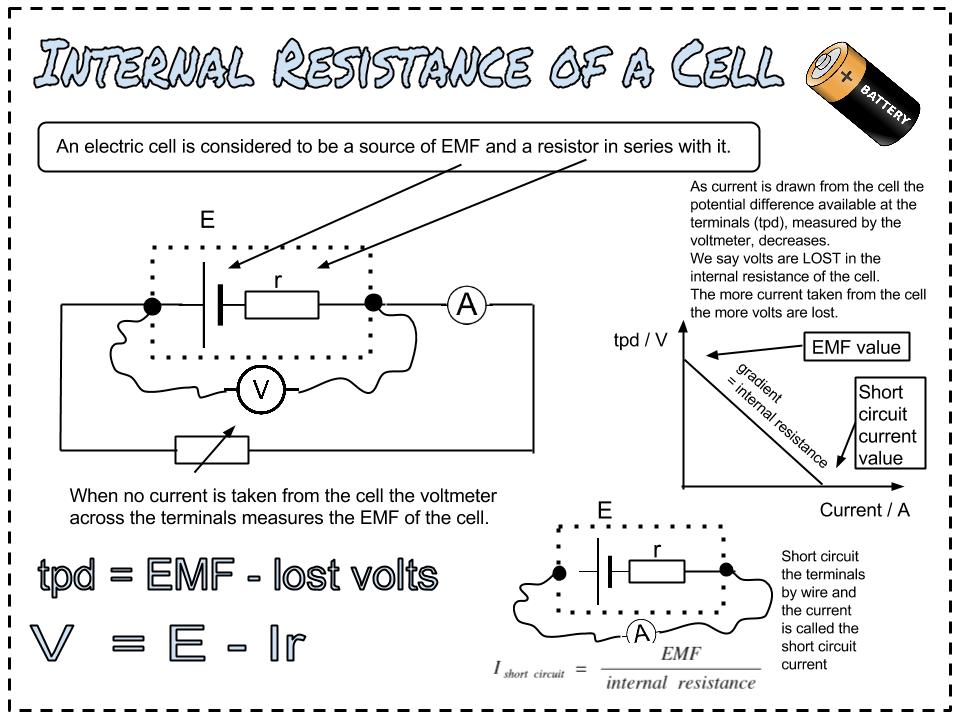
In the simulation below it can be seen that when electric current is taken from an electric cell the potential difference between the terminals decreases.
When no current is taken the tpd is at its maximum. This is the EMF of the electric cell.
The EMF of an electric cell is the maximum energy given to each Coulomb of electric charge.
This lost energy per coulomb, usually called "lost volts" is lost in the internal resistance of the electric cell.
You can download a poster for your notebook below.
Hi physics lovers. Check these two videos below on internal resistance.
How to calculate the internal resistance of a cell.
Investigating the internal resistance of a cell.
You can download the physics simulation from the here:
Roll mouse over the V, W and Q for definition of these terms.
When a physicist talks about a field they are not talking about the green ones with
cows in it.
Rather they mean regions of space where objects experience a force without being touched.
To picture these regions in space physicists use arrowed lines.
The direction of the arrows show the direction where the objects experience the force.
Here are the Higher physics starter questions of the week.
You can make the questions full screen by pressing the appropriate controls on the slide.
Clicking the slide will reveal the answers
When a car is in collision with a wall which brings it to a stop its momentum must be reduced to zero.
The change of momentum of the car is equal to the impulse it receives.
Impulse = change of momentum.
Ft = change of momentum
Now this change of momentum can come about with a LARGE FORCE acting over a small time or a small force acting over a LONG TIME.
The above movie shows the force time graph of two collisions of a car with a wall and then a collapsible wall.
Assuming the car is travelling at the same speed before each collision the change of momentum will be the same in each case.
You can calculate the change of momentum from the area of the force time graph. Note each graph has the same area but the time to change the momentum is different.
You will notice that in the collision with the collapsible barrier the time for the change in momentum is longer. This means that to keep the same area the peak force will be lower.
So to survive collisions it is important to increase the time you take to come to a stop. That is why car safety needs airbags, seat belts and crushable car fronts.
