Nasty Nine Radiation
Hi Physics luvvers! Here is your last Nasty Nine of the season. Remember it is only nasty if you have not studied;-)
Categories: National 4,Physics Class
14Jun
Comments Off on Nasty Nine Radiation
Hi Physics luvvers! Here is your last Nasty Nine of the season. Remember it is only nasty if you have not studied;-)
Started Standard Grade Physics with my new S3.
We thought about what we would explore on our two year journey as though we were embarking on a similar journey into space.
As a class we wrote down what areas of knowledge and expertise would be needed to make the space journey successful.
Well what we wrote down was remarkably like the topics we will be studying over the next few years.
Well done S3 and the best of luck for your Standard Grade journey into physics.
Colliding Particles – Episode 2: Big Bang Day from Mike Paterson on Vimeo.
OK so you have chosen to study physics over the next two years at Standard grade or have chosen Intermediate 1,2 or are even crashing the Higher.
Congratulations! You have chosen a cracking good subject in physics and I wish you well.
Want to see top class physicists in action? Then follow this brilliant series documenting the lives of physicists working at the Centre of European Nuclear Research (CERN) in Geneva Switzerland.
I had the great privilege of visiting CERN last week along with 15 other physics teachers from all over Scotland. It was great to see people from all over the world working on the great mysteries of the Universe.
Who knows that by the end of your school physics you could be on your way too to answering the great questions of science.
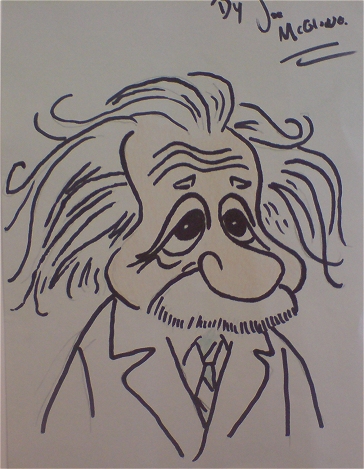
Here is a sketch of Albert Einstein by Joe McGlone.
Joe is a third year pupil in my physics class.
I think it is a cracking good likeness and has caught something of the great man.
Well done Joe.
The distances in space are far too large to be measured in kilometres. It is a bit like marking the road distances in millimetres.
Instead astronomers use the light year. The light year is the distance a beam of light travels in one year.
You can use the fantastic Wolframalpha website to explore the distances in space and on Earth in terms of how quickly a beam of light will take to cover he distance.
All you have to do is type into the box light year. You will find the distance a light year in metres.
Try typing in:
Glasgow to Paris. You can equate the distance in terms of how long it would take light to travel this distance = 2.99milliseconds. So we could say that Paris is about 3 milli-light-seconds from Glasgow.
Try typing in Earth to Mars you`ll find that the distance between Earth and Mars is 9.6 light-minutes.
You can download a special worksheet which you can use with Wolfram Alpha.
Download worksheet here. (pdf)
WolframAlpha
Have fun converting distances into lightyears, lightminutes or even lightmilliseconds.
I hope you have completed your bootcamp question booklet and you now have to complete your Easter revision booklet.
I will post the answers over the holidays, so keep looking at the Standard Grade Zone.
Anyway have a happy Easter holiday but remember to work hard.

Fancy yourself as a theme park creator? Then try out this wonderful simulation.
Watch out for the changes in energy. Check out how gravitational potential energy can be changed into kinetic energy.
Go on! Have some fun with physics.
Hi physics lovers! Here is a wee movie we filmed using our physics monkey to show us how seatbelts prevent drivers and their passengers from being injured when their cars stop suddenly.
Have some fun with this latest Mr Mallon`s Nasty Nine.
Good luck.
