Higher Assignment 007
Hi physics lovers here is the Higher Assignment question 2 worked answer:
Higher Assignment question 3 worked answer.
Download your copy of Higher Assigment 007 here
Hi physics lovers here is the Higher Assignment question 2 worked answer:
Higher Assignment question 3 worked answer.
Download your copy of Higher Assigment 007 here

The last couple of days at St Andrew`s we have been investigating light and sound. One day we researched Isaac Newton and what happened when he passed white light through a triangular piece of glass called a prism.
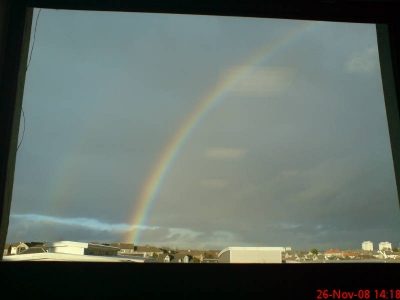
Isaac discovered that white light is made up from all the colours of the rainbow. Suddenly there it was! Outside the window. Yes it couldn`t have happened at a better time… a rainbow!
Wow! This rainbow was much better than any picture we saw in the lab!
Isn`t nature so cool!
Rainbows from the MET Office
Isaac Newton
Here is the worked out answer to the Higher Physics 005 Assignment question 2a.
The question is about finding the velocity of a car wreckage after a collision. The key point is to use your momentum flags!
Peter Atkins wrote an excellent science book about the periodic table. His book was called The Periodic Kingdom, a journey into the land of the chemical elements.
Two girls in my second year science class, who are studying the periodic table, wrote a lovely story about an imaginary journey around their periodic table poster.
Olivia McKenzie and Eve Prentice recorded the above reading of their stories.
So sit back and enjoy their imaginary trips.
My first year classes have had great fun exploring light and how it reflects off mirrors and passes through glass blocks. For the past few weeks we`ve worked in the dark and discovered fascinating facts about light.
Here are some great ideas…
Light and mirrors helps your snooker!
Isaac Newton loved glass prisms and found a fabulous fact that white light is not what it seems.
Light rays can be bent.
Have some fun looking at our presentation, sound will follow.
Here is the worked out answer to question 3 of Higher Assignment 005. This is the question about calculating a rocket`s acceleration at lift off when you know the rocket`s thrust and weight.
You can download this little movie and keep it on your ipod or media player.
More worked answers will follow.
Meanwhile take a look at this link about how rockets work
Here are the latest Higher physics assessments. Click on the links below to download copies.
Higher Physics Assessment 004
Higher Physics Assessment 005
This is a wonderful experiment we did in our science classes during Halloween week. Water with some red dye is pushed up a pipe into a conical shaped flask. How does it happen?
Well it has to do with air pressure.
At the start of the experiment some water is brought to a boil in the conical flask. Some of the water that is boiled changes state into a gas which takes up the whole space of the conical flask.
The conical flask is closed with a stopper with a long pipe inserted into the stopper. The flask is then turned upside down and the long pipe is inserted into a beaker containing dyed water.
The water gas cools back into a liquid and his causes a vacuum to exist in the conical flask
This vacuum has much less pressure than the air presure pushing down onto the red dyed water. This results in the red dyed water being pushed up the pipe into the flask. This cools the water gas more causing a bigger vacuum which makes a bigger presure difference. The dyed water the is pushed harder and a fountain appears in the conical flask.
Listen out for a horrendous noise as Dracula sooks up the last of his blood…..
Thanks to Maria Devlin for kindly videoing the experiment.

In our science lab the other week we tried a very puzzling experiment. The class added together 40millilitres of alcohol and water. Surprisingly the mixture added up to about 78 millilitres amd not the expected 80 ml.
Like a good science class we tried the experiment a couple of times and yes it still gave us the same result.
We found out that 40ml of water added to 40 ml of alcohol gave 78ml!
Ciara McGhee, Chloe McMullen and Leanne Moan recorded their ideas about this experiment. Have a listen!
We have found out that hot air rises. This is because it expands when warm and becomes less dense compared to the surrounding air. Less dense air will rise upwards.
In the video above we see what happened when we placed an ice cube with some dye inside. The ice cube cools the water surrounding it and this contracts the water making it more dense than the surrounding water. So it sinks.
Science is so cool!