Oscillations and Waves
Here is a simulation of a spring with a mass attached.
Press the play button to start.
5Feb
Comments Off on Oscillations and Waves
In this code I have added a slider to change the value of the acceleration of the floor.
Think of the floor of an elevator.
A positive acceleration indicates that the elevator is accelerating upwards and a negative acceleration indicates a downward acceleration.
Press the play button to start the program and then the pencil button to examine the code
Here is a vpython code to visualise the normal force acting on a block sitting on the foor.
The normal force is provided by the floor. You can think of it as a supporting force.
If the normal force was removed the box would be in freefall!
Think of standing on a trampoline. The trampoline webbing provides an upwards force to stop you falling.
This normal force would be the reading on a weighing scale.
Change the value of acceleration variable “a” in the code to see what happens to the normal force when the floor is accelerating upwards or downwards
The normal force is the reading of the weight in newtons on the weighing scale.
What is your weight reading when the floor is accelerating upwards, ie a positive acceleration and when the floor is accelerating downwards, a negative acceleration?
Press the small pencil to change the code. Then run.
The black car is moving towards an observer,represented by the green ball, while sounding its horn.
The sound waves spread out from the car. Notice that the sound waves squash up as the car approaches the observer and stretch out as the car leaves the observer behind.
Press the run button to start the program.
Can you see why the observer hears a higher frequency of sound as the car approaches and a lower frequency of sound as the car moves away?

In Our Time: The Electron BBC
If you are investigating sound frequency while studying waves and have access to a BBC Microbit then have some fun coding to hear the octave of a frequency.
An octave means that the frequency is doubled. Pressing one button creates a sound of frequency 256 Hz and pressing the other double the frequency to 512 Hz.
Have some computing physics fun with the microbit.
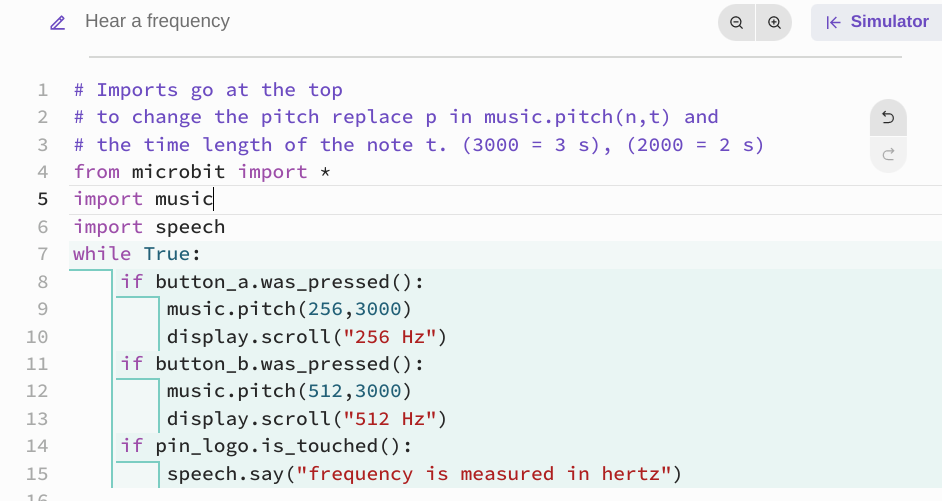
The above code can be typed into the microbit python editor.
Here is a reason why young physicists should be coding. This example is a bit complicated but following the basics of VPython you can become quite experienced.
Play this in full screen.
