Jamie Lang of Mr Mallon`s Physics class shows how to measure the speed of sound using two microphones attached to an electronic timer.
The distance between the microphones was 1 metre.
Mr Mallon`s second year science class used their mobile phones to take pictures of cells.
Using their magnifying capability we examined the cells in detail and discovered each cell has a nucleus.
Andrew Jackson brought in some pond water which was teaming with microscopic life. Check out the amazing picture of a midge larvae captured in class. Awesome picture.
Thanks to Andrew Jackson for providing the pond water.
PS Mobile phones in class can be a powerful tool when used appropriately, well done S2.
Hi First Year scientists!
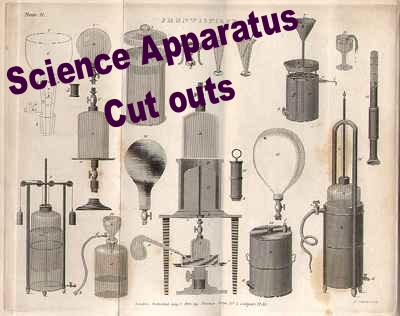
Do you want to make your science reports look fantastic? Then click on the link below to download a sheet with some of the common science apparatus you will be using in Mr Mallon`s science lab.
You can print out the sheet and cut out the pictures of test tubes, beakers or flasks when needed for your report.
I hope you are enjoying your summer holidays.
Just in case you are feeling bored, which I doubt it, here is a wee picture summary of some of the things we did last session.
Ever wondered which is faster between light and sound?
Well our new standard grade physics class along with our technician Mr McKenna set out to race sound and light.
We used a special machine that activated a flash lamp when it detected sound. So the light flashed at the same time as the sound was created.
Can you think of anything in nature where sound and light are created at the same time?
Who will win the race. Check out the video!
During my visit to CERN I had the privilege to speak to particle physicist Rolf Landau. Rolf gave our sixteen strong Scottish physics teachers (plus about fifty English physics teachers) three lectures on the history of particle physics.
Rolf also hosted a couple of question and answer sessions about various aspects of what is happening at CERN.
It was Rolf`s introduction about the curiosity that is needed to become a great physicist that caught my imagination.
I took the opportunity to ask him to record that advice to the many Scottish young people who are about to take up Physics.
You`ll find the recording below.
Started Standard Grade Physics with my new S3.
We thought about what we would explore on our two year journey as though we were embarking on a similar journey into space.
As a class we wrote down what areas of knowledge and expertise would be needed to make the space journey successful.
Well what we wrote down was remarkably like the topics we will be studying over the next few years.
Well done S3 and the best of luck for your Standard Grade journey into physics.
OK so you have chosen to study physics over the next two years at Standard grade or have chosen Intermediate 1,2 or are even crashing the Higher.
Congratulations! You have chosen a cracking good subject in physics and I wish you well.
Want to see top class physicists in action? Then follow this brilliant series documenting the lives of physicists working at the Centre of European Nuclear Research (CERN) in Geneva Switzerland.
I had the great privilege of visiting CERN last week along with 15 other physics teachers from all over Scotland. It was great to see people from all over the world working on the great mysteries of the Universe.
Who knows that by the end of your school physics you could be on your way too to answering the great questions of science.
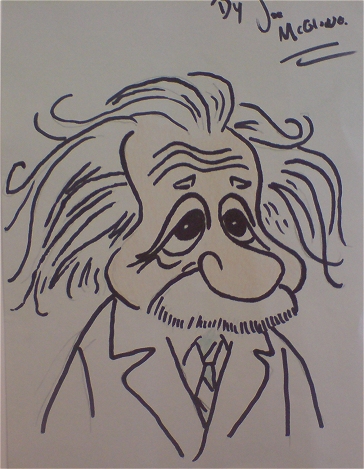
Here is a sketch of Albert Einstein by Joe McGlone.
Joe is a third year pupil in my physics class.
I think it is a cracking good likeness and has caught something of the great man.
Well done Joe.