Investigating the speed of light.

Posted by Mr Mallon on April 16, 2010

wolflight

The distances in space are far too large to be measured in kilometres. It is a bit like marking the road distances in millimetres.
Instead astronomers use the light year. The light year is the distance a beam of light travels in one year.

You can use the fantastic Wolframalpha website to explore the distances in space and on Earth in terms of how quickly a beam of light will take to cover he distance.
All you have to do is type into the box light year. You will find the distance a light year in metres.

Try typing in:
Glasgow to Paris. You can equate the distance in terms of how long it would take light to travel this distance = 2.99milliseconds. So we could say that Paris is about 3 milli-light-seconds from Glasgow.
Try typing in Earth to Mars you`ll find that the distance between Earth and Mars is 9.6 light-minutes.

You can download a special worksheet which you can use with Wolfram Alpha.

Download worksheet here. (pdf)
WolframAlpha

Have fun converting distances into lightyears, lightminutes or even lightmilliseconds.

16Apr
Comments Off on Investigating the speed of light.

Easter Holidays 2010

Posted by Mr Mallon on April 1, 2010

I hope you have completed your bootcamp question booklet and you now have to complete your Easter revision booklet.
I will post the answers over the holidays, so keep looking at the Standard Grade Zone.

Anyway have a happy Easter holiday but remember to work hard.


Get a Voki now!

1Apr
Comments Off on Easter Holidays 2010

The God Particle

Posted by Mr Mallon on March 28, 2010

Click on the picture below to read an interesting article about the Large Hadron Collider (LHC) which will be switched on this week


Sunday Herald
28 Mar 2010

Categories: Physics News
28Mar
Comments Off on The God Particle

S1 Energy Flow Word Search

Posted by Mr Mallon on March 17, 2010

Categories: Science Classes
17Mar
Comments Off on S1 Energy Flow Word Search

First Year Carbon dioxide experiment.

Posted by Mr Mallon on March 13, 2010

viewVideo.php?video_id=167203&title=Carbon_Dioxide_Experiment&ref=dmallon

Here is a video taken with my first year class when we demonstrated that carbon dioxide gas is heavier than air.
We put two plastic bags at the end of a long piece of wood.
Then we balanced the beam of wood and poured out the invisible gas made by adding vinegar and baking soda.
Later we tested the gas with lime water. The gas turned the lime water milky. This test told us the gas was carbon dioxide.
Well done 1/7.

Categories: Science Classes
13Mar
Comments Off on First Year Carbon dioxide experiment.

S1 Pyramid of Numbers

Posted by Mr Mallon on March 11, 2010

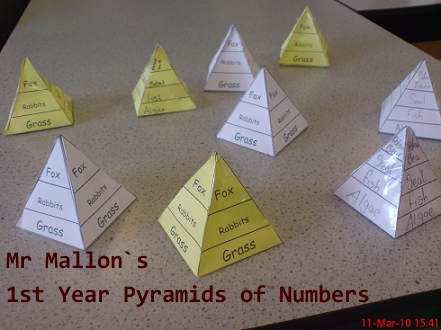
Pyramid of numbers

My S1 class enjoyed making three dimensional pyramids showing the numbers of organisms at each level of the food chain.
The base of the pyramid is larger because there are lots more plants than rabbits. Lucky rabbits.

Some questions.

  1. What kind of consumer is the fox?
  2. Can you think of a pyramid of numbers which is an upside down pyramid?

You can download a pyramid of numbers cut out sheet and enjoy making a 3D pyramid of numbers for homework.

Download your own cut out pyramid of numbers here.

Categories: Science Classes
11Mar
Comments Off on S1 Pyramid of Numbers

Food Chain Fun!

Posted by Mr Mallon on February 22, 2010

foodchains

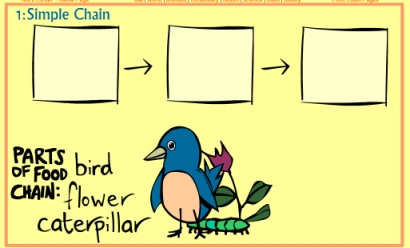
Click the above picture to have some fun completing food chains.

Categories: Science Classes
22Feb
Comments Off on Food Chain Fun!

Intermediate 1 Nasty Nine Test 02

Posted by Mr Mallon on February 19, 2010

19Feb
Comments Off on Intermediate 1 Nasty Nine Test 02

Investigate electric circuits.

Posted by Mr Mallon on January 19, 2010

phet

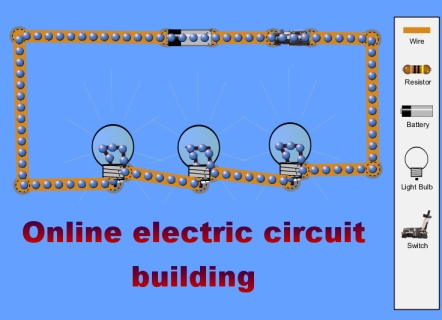
This is a great site to help you understand the electric circuits you have been studying.
You can run it on your computer or download it and use it offline.

PHET Circuit Construction

19Jan
Comments Off on Investigate electric circuits.

Merry Christmas.

Posted by Mr Mallon on December 21, 2009

I set my young scientists a Christmas Poster competition, all they had to do was dream up the best present that a scientist could find in his/her stocking on Christmas morning.

Have a Merry Christmas and a Happy New Year.

Categories: Science Classes
21Dec
Comments Off on Merry Christmas.